03 February 2013

How I made our computer quiet

One of the two (!) fans in our computer's power supply has been getting more and more raucous over the past few months. I don't know whether this means it was close to actually stopping, but it was certainly close to actually driving me crazy. So, somewhat out of character for me, I decided to finally try to do something about it. Big mistake.

I found the following three options for what to do.
  1. Lubricate the fan.
  2. Replace the fan.
  3. Replace the power supply.
I decided to replace the power supply. It seemed a little wasteful, but lubricating the fan didn't seem guaranteed to succeed and I was scared off of replacing the fan by warnings about capacitors holding a charge for hours.

A brief digression. I found it amusing to see, in an online discussion of what lubricant to use, a British person asking for the equivalent of "gun oil" since shops in his country don't commonly sell it, or sell guns, for that matter! (It was speculated that "sewing machine oil" would be similar.)

So I was determined to get a new power supply but not spend a huge amount of time figuring out what the best one would be. I fear I waste a lot of time shopping online for things, optimizing on margins that don't matter. Well it turns out it would have been worth spending some time figuring out what a correct one would have been, leaving aside the question of what the best one would have been.

I found some random site that offered a nice-looking lookup of power supply by computer name, and trusted it. Big mistake.

It turns out there has been a lot of evolution of the ATX power supply standard over the years. As is so often the case, there's a good Wikipedia article covering it. I only wish I had read it before plugging my new power supply in. (Digression: since it is so often the case that there is a good Wikipedia article about things, I've recently donated to Wikipedia, and plan to do so regularly, and encourage you to do so, too, if you find it useful.)

So, I plugged my new power supply in, and everything seemed fine, but when I came back a few hours later, there was a strange smell in the room and the computer was off and would not turn back on, even with the old-but-noisy power supply plugged back in. Woops.

So, making good on the promise implicit in the title of this post, that's how I made our computer quiet. Very quiet. One might even say silent.

I lack some combination of the skill and the inclination to figure out exactly what happened, but my not-too-wild guess is that you shouldn't plug a 20-pin power supply into a 24-pin motherboard. I guess I was hoping that if it wouldn't work, it just wouldn't work. Meaning, I hoped that if it wouldn't work, it would fail in the following three ways.

  1. obviously
  2. immediately
  3. non-destructively

Well, it did fail obviously. But not immediately, and not non-destructively.

Was my wishful thinking a product of "overly digital" thinking? Though digital systems have plenty of non-obvious, non-immediate, destructive failure modes, somehow I think analog systems have even more.

And power supplies are about as analog as you can get. In fact, they're not even analog: they're power! Power is the analog of nothing! Or, put it this way, I've never heard of power being used as the analog of anything. Voltage, certainly. Current even, sometimes. But power, never.

Returning from that digression, my point is, that what probably happened is that things did work, initially, and then once something heated up, over time, something on the motherboard melted or burned.

It turns out that those 4 extra pins are supplying "redundant" 3.3, 5, and 12 V lines, as well as ground. Not having them forces the other pins to carry more than their "fair share" of the current. Unfortunately I guess the weak point in the system was on the motherboard, not in the power supply. Otherwise plugging the old power supply back in would have worked.

So then I set about spending several should-have-been-sleeping hours researching the current offerings of Dell and HP. In other words, my mistake has led me to the most wasteful option, the following implicit option number 4.
  • Replace entire computer.
Whenever I research buying a new computer I'm always shocked by the way in which each manufacturer divides their products into confusing, overlapping market segments, where it seems like the same computer is being offered over a 4x price range with the only obvious difference being different case design. (It turns out there are deeper differences, you just have to spend several hours to start to get a grasp of them. Whether these differences justify the 4x price range... well, if the market bears it, I guess the answer is revealed to be "yes.")

So, I'll be spending a little quality time over the next few days setting up a hopefully-nice new Windows 8 machine.

Still to be determined whether I will shell out $100 to upgrade from Windows 8 to Windows 8 Pro. I am curious to try to run Ubuntu under the "Hyper-V" virtualization built into Pro, but probably I should just save $100 and use VirtualBox, like I do with great success and ease on MacOS on my MacBook Pro.

Also, will we ever want to connect to the machine using Remote Desktop? For that, you need Pro.

Decisions, decisions.

But at least these decisions are back in the realm of software, where I feel more comfortable.

Because if there's one take-home lesson from this experience, it is that I shouldn't have felt comfortable in the realm of power. She is a cruel mistress, the analog of nothing.

28 December 2012

The Chapman Exchange

I spotted the following use of the old "2L-5N" (2 letter, 5 number) dialing instructions on a sign on a fence at Rancho Park Golf Course in Los Angeles.


The sign advertises the Cyclone Fence Division of American Steel & Wire Co.

It also mentions United States Steel. Was American Steel & Wire Co. just a part of that (USS)?

Anyway, the address given is 5532 San Fernando Road, Glendale, Calif.

And the phone number, the reason for my interest, is CHapman 5-2635.

The sign also advertises locations in Oakland, San Francisco, Seattle, and Portland.

Though the use of 2L-5N is what most caught my attention, the typography is pretty neat, too. In particular, the big fat font used for the main text of "CYCLONE FENCE."

16 November 2012

Digitizing your books

Here's what I've learned so far about digitizing books for personal use.

How should you scan your documents?

The scanning service I've tried is called 1DollarScan. It works well. For a base price of $1 per 100 pages, they will (destructively) turn your book into a PDF. They offer various extra services, each of which costs an additional $1 per 100 pages. Some of these extras are listed below.
  • 600 dpi (instead of 300 dpi)
  • Ship from Amazon.com. That way you can "pretend" any book on Amazon is available as a PDF!
  • OCR. I gave it a try but was not particularly impressed. So now I plan to do the OCR myself using Acrobat. Acrobat has an amazing option called "ClearScan" that replaces recognized characters with their representation in a custom font. I'm still keeping the original scans for reference, in case ClearScan messes up, but so far it has offered me about 18x compression at what appears to be an increase in quality!
  • Use book title as file name. I gave it a try, and it was fine, but now I plan to just name my files using their ISBN, e.g. "ISBN 1234567890". I plan to put the title and author in the PDF metadata. This keeps file names short, though it makes them unfriendly. I'm assuming this unfriendliness won't be a problem since I'll find things by searches of content as well as file name, where the content will include the title metadata as well as the OCR data for the images. If you do go with titles in file names, note that many titles can't be exactly represented as file names since they contain characters prohibited from file names. E.g. on Windows, a colon is prohibited, but it is a very common character separating title from subtitle! As one would expect, the title field of the PDF metadata has no such restrictions.

Now, where should you put your scanned PDF?


I've tried storing PDFs on Dropbox, Google Drive, and Scribd. I think Google Drive is the best overall. Here is a comparison of what these services offer.
  • Dropbox
    • No file size limit
    • 2 Gb overall limit for free accounts
    • Offline access
    • Native viewers (Acrobat, Preview)
    • Native search (Windows Explorer, Mac Finder)
  • Google Drive
    • 25 Mb file size limit for in-browser viewer and in-browser search
    • 5 Gb overall limit for free accounts
    • Offline access
    • Native or in-browser viewer
    • Native or in-browser search
  • Scribd
    • 100 Mb file size limit; much smaller for ClearScan?
    • No overall space limit for free accounts
    • No offline access
    • In-browser viewer
    • In-browser search
For reference, the books I've scanned have been in the 100-200 Mb range. So to accommodate either Google's 25 Mb limit or Scribd's 100 Mb limit, you would have have to split such PDFs up. In Acrobat, you can do this by adding bookmarks at the beginning of each desired section and then telling it to split the document accordingly.

Or, you can compress your documents using Acrobat's ClearScan and then they will probably fit even Google's 25 Mb limit. So far, I haven't gotten Scribd to accept ClearScan files that were bigger than 100 Mb before they were compressed, though. My guess is that when they are converted to Scribd's format, they end up being too big again.

One thing I noticed about Scribd's viewer: it doesn't show you the full resolution of your document, at least not if it is 600 dpi. I suppose you can download the PDF if this is a problem, but that might be mildly annoying.

Unlike Scribd, Google Drive allows files greater than 100 Mb. But, a PDF bigger than 25 Mb won't be searched or shown in the built-in viewer. In other words it is just an opaque (dumb) bunch of bits.

Okay so that's what I have to share about my experiences digitizing books. What follows is a postscript on the narrow issue of how to fix PDF search on 64-bit Windows.

Postscript: How to fix PDF search on 64-bit Windows

One of the big advantages of having your books digitized with OCR is the ability to search within a book and among all your books. To my dismay, this was not working for me on Windows.

The reason, I discovered, to my horror, is that on 64-bit Windows, PDFs won't be indexed unless you install a special "IFilter" program from Adobe. Once I did this and rebuilt the index, PDF search started working.

In my opinion, this is really bush league stuff from an otherwise major league company like Adobe. Though a little weird, I respect their choice to not have a 64-bit version of Acrobat. The 32-bit version works fine and I suppose Acrobat is unlikely to require more than the 2 Gb or so of memory that would trigger the need for a 64-bit version. But, they should have figured out how to install this 64-bit IFilter thing along with the 32-bit application, when it is being installed on a 64-bit OS.

I try not to indulge in Windows-bashing or Mac booster-ism unless I have something specific to say. So I guess I'd modify the adage
If you don't have anything nice to say, don't say anything at all.
to
If you don't have anything specific to say, don't say anything at all.
Here I have something specific to say. Mac's built-in PDF support is nice. You get a viewer (Preview) and search right out of the box. On Windows, it is mildly annoying that one must install a viewer (usually Acrobat Reader) on each new machine, but it is close to infuriating that indexing (search) doesn't work even when you do that install! Without some intrepid Googling to figure out that this is a 64-bit problem, you won't be able to figure out why indexing works on some machines and not others. (The answer is that some machines are running 32-bit Windows and some machines are running 64-bit Windows!)

17 October 2012

The daleth and the resh, part 1 of 2

Introduction

Here's what the Hebrew letters daleth and resh look like.

רד

With that in mind, consider the following excerpt about Isaiah 33.8.

The RSV, NRSV, NAB, and NIV follow 1QIsaa in reading
ʾdym [‘ê·ḏîm] [עֵדִ֔ים] [concordance] “witnesses”
instead of the MT
ʾrym [‘ā·rîm] [עָרִ֔ים] [concordance] “cities.”
“Witnesses” seems appropriate to the meaning of the passage, and the interchange of resh for daleth is understandable in light of the similarity of the letter shapes. The NJV also calls attention to this reading in a footnote.
Harold Scanlin, The Dead Sea Scrolls & Modern Translations of the Old Testament, p. 130

This got me thinking, how should one go about writing a sacred text in a way that avoids such problems?

Or, more generally, how should one go about writing a text that needs to be transmitted with high fidelity, i.e. faithfully. Sacred texts are just a specific example of this. The situation reminds me of an old FedEx slogan:

When it Absolutely, Positively has to be there overnight.

So, sacred texts are those where it absolutely, positively must be copied right. Yet, historically, they have fallen far short of this. At least, this is true of the sacred texts of Judaism, which are the only ones I know anything about.

The following is a rambling set of comments on the topic of faithful transmission of text. I'd like to be able to call it something more profound, like an "extended meditation," but it is really just a ramble. As the title suggests, it is the first of what I hope will be a two-part whole.

Avoid homoglyphs

The first rule of faithful transmission is "avoid homoglyphs." Well, really it should be "avoid homoglyphs and near-homoglyphs," but that isn't as catchy. Anyway, it is just a fancy way of saying "use letterforms that look different."

Hebrew homoglyphs

Hebrew is littered with near-homoglyphs. We've already seen the issue with daleth and resh; here it is again, along with various other issues.

נג כב עצ זןו רדך סם

A more detailed presentation of these issues is available on the following web page. (Note that it shows Sofit and Fey Sofit in their cursive form. Their printed forms are not easily confused.)

Similar Hebrew Letters
DIGRESSION By the way, this "Hebrew for Christians" site is an example of a general pattern:
Some of the best resources for studying the Tanakh are for studying the Old Testament.
Whether this is a good thing or a bad thing, or just a thing, neither good nor bad, I will perhaps opine on in another blog post. But I will remark here that it feels a little strange to me. But that feeling itself is a little strange, since when I step back and think about it, it is not surprising that it should be the case. Our sacred texts our sacred to them, too. And, while numbers don't tell all, I'll just point out that there are something like 150 times as many Christians as Jews in the world.

English homoglyphs

Anyway, back to homoglyphs (and near-homoglyphs). To be fair to Hebrew, English is not immune to this problem. Or, rather, the Latin alphabet and Arabic digits are not immune to this problem. For example consider the following characters.

  • 1 (the digit one)
  • I (the letter capital I as in India) (henceforth "CI")
  • l (the letter lowercase el) (henceforth "LL")

Putting all three together, you get "1 I l." How much these differ depends on whatever font is operative. For some edification and entertainment, I recommend typing "1 I l" in at one of the following sites:

flippingtypical.com
wordmark.it
NOTATIONAL
ASIDE
I chose "India" as an example of a word starting with I since that's the choice of the NATO phonetic alphabet, which is designed to give letters different-sounding names, solving a problem analogous to the one we are discussing here.

Are homoglyphs "wrong"?

I think we have to let sans serif fonts off easy on the CI/LL distinction. Though the distinction can be made with full strokes, not just serifs, I feel that it is not really in the charter of a sans serif font to have to make distinctions like that.

More generally, we can't say that any font is wrong if it fails to make one or more of these distinctions. Fonts serve a variety of purposes; their design goals span concerns of form, function, and the great gray area in between. Many of these goals are at odds with each other, and hence trade-offs must be made. In the service of one goal, another goal may be sacrificed, or at least compromised. For example, if simplicity of letterform is allowed to trump distinctness of letterform, then perhaps one, CI, and LL would be allowed to be very similar or even the same.

That having been said, for most purposes, distinctness of letterform is a very important goal for a font. Thus a font intended for general use should give this goal great weight in making its design trade-offs.

One and CI

My particular interest is the one/CI distinction. The most common problem here is a one that looks like CI. The above sites allowed me to quickly identify the following fonts on my computer as "offenders" in this area.

Hoefler Text
Big Caslon

A Roman-style one (henceforth "R1"), i.e. a one that looks like CI, is common as part of what are called old-style numerals or old-style figures (OSF). Such a one may be distinguishable (with effort) from CI since it is usually only x-height. Even then, when mixed with a small caps CI, the problem may persist. This might seem an obscure situation, but the use of small caps for acronyms is a somewhat common style.

Here's the story of how Vice President Al Gore caused the one in the Brioni font to be changed from Roman to Arabic to make it easily distinguishable from CI.

Roman ones and the Great Isaiah Scroll

Let's get back to the sacred. Strangely enough, my first experience of one/CI confusion happened while reading about some famous daleth/resh confusions of more than two thousand years ago! The very perceptive reader may have noticed the opportunity for one/CI confusion in the prickly-looking abbreviation "1QIsa" that appears in my opening quote.

"1QIsa" is an interesting opportunity for confusion. On the positive side, it has a one and a CI, making slight differences between the glyphs easier to see than if they appeared independently and the reader had to find and compare far-flung examples. Also on the positive side, many readers would know, from context, that the third glyph is a CI since it begins an abbreviation for Isaiah. Slightly fewer, but still many readers would know, from context, that the glyph before the Q is supposed to represent a number.

But here begins the real problem. When the one resembles a CI, is the reader to infer that the convention is to use Roman rather than Arabic numerals? For the trivial case of the number one, it doesn't really matter, since they represent the same thing. But for the case of the number eleven, confusion could be serious, since R1 glyphs would make eleven look like the Roman numeral representation for two. And, as it turns out, there was a Cave 11 at Qumran, containing, among other things, the Great Temple Scroll (11QTa).

Let's see how the Great Isaiah Scroll is referred to in the NJPS translation of Prophets (Nevi'im) that was first published in 1978 (ISBN 0-8276-0096-8). (This is not the first publication of its translation of Isaiah; that was in 1973.)

First, we should note that the NJPS Prophets abbreviates Isaiah to just "Is" as opposed to the more standard "Isa." Perhaps that standard had not been established yet, and in any case that's not our issue here.

Our issue here is that its typesetting of "1QIs" visits the whole gamut of the one/CI/LL confusion. The one is represented

  • confusingly, an R1
  • incorrectly, as LL
  • correctly, as an Arabic one (henceforth "A1")

The CI is represented

  • incorrectly, as an LL
  • correctly, as a CI

Below are scans of examples of its different settings of "1QIsa." The page numbers and the representations of one and CI are listed in the first row. Apologies that these are bilevel rather than grayscale images.

356: R1 / LL 368: LL / CI 369: R1 / CI 468: A1 / CI

This was all fixed, to A1/CI, in the 1985 NJPS Tanakh. More generally, the 1985 Tanakh moved to using A1 rather than R1 in footnotes.

And then came the digital age.

What promise it offered, and continues to offer! Yet, what typographic barbarisms it has facilitated. I suppose that only from great heights can great falls happen. Another way I've seen it well-put is:

To err is human; to really screw things up requires a computer.

Don't get me wrong, my Kindle version of the NJPS Tanakh is one of my prized possessions, inasmuch as something so intangible can be thought of as a possession. But somehow one/CI confusion in "1QIs" crept back in, with a vengeance. In particular, the one is usually represented as a CI.

Below are scans of examples of its different settings of "1QIsa." The Kindle locations, Kindle and printed page numbers, and the representations of one and CI are listed in the first row.

16293 / 762 / 633: CI / CI 16330 / 762 / 640: A1 / CI
DIGRESSION In typical great heights/great falls fashion, Kindle locations offer citations of intriguingly high resolution, but all footnotes have been converted to endnotes, and thus all Isaiah footnotes appear to be on the last page of Isaiah, 762. Within the hyper-linked Kindle world, this doesn't really matter. For citations that "work" for the printed version, you need to follow the endnote's hyperlink "backward" to find the real page.

In the Kindle edition, how can we know whether the one is being represented by a CI or an R1? Well, for one thing it is visually identical to other CI glyphs, but, more deeply, if you copy and paste it, it is a CI; and if you search for IQI (CI-Q-CI), you'll find those instances that use it.

An important consequence of this is that if you search for 1QI (one-Q-CI), you won't find the IQI (CI-Q-CI) instances. And here we really find form spilling over into function. So far all my complaints about the typesetting of "1QIs" could be dismissed as the whinings of an aesthete with too much time on his hands. I would mostly disagree with this characterization, but would have to admit that function was only impaired, not destroyed by these problems. If we narrowly define function as transmitting the meaning, "Isaiah manuscript from Cave 1 at Qumran," then these problems probably did not destroy function for most readers. They probably just made it more difficult to decode this meaning, i.e. they only impaired function.

But the digital version adds (or should add) a new function: the ability to search. And this was not just impaired but destroyed by the misrepresentation of one as CI.

DIGRESSION When one is represented as one in the Kindle edition, it shows up as an Arabic, yet old-style, figure. This and other research leads me to believe that Georgia is the font used by the Kindle Reader for Mac. Or at least it is the font used when a serif, proportional font is requested. Note that you can't easily change fonts on any Kindle-reading platform. That's why I said it is "the font," not "the default font." On Kindle hardware, the font seems to be PMN Caecilia, which has a lining one, i.e. a non-old-style one. Some fonts may have an option for both lining and old-style figures, and perhaps even an option for both an Arabic and Roman old-style figure for 1. I'm not sure if either of these fonts do, but the relevant question here is what does their default one look like.

Conclusions

If you have the luxury of making up your own alphabet, avoid homoglyphs. This luxury is rarely available; the only recent example I can think of is the invention of the Klingon alphabet. I wonder how distinguishable its glyphs are.

DIGRESSION Another "I wonder ..." about a recent example: did anything analogous to daleth/resh confusion ever happen with the Book of Mormon?

Back to obvious conclusions: if you, like most of us, are stuck using someone else's alphabet, choose your fonts so as to avoid homoglyphs. For example, avoid fonts with Roman ones if the text you're setting might use them in a way that would cause confusion. Perhaps you don't need to avoid the font altogether if it provides an Arabic one as an alternative.

Finally, let's zoom out to a theological question: if Isaiah's words are holy, why didn't G-d give him a better alphabet to record them in?

My suggestion is, the Hebrew alphabet is no more the alphabet of G-d than the Hebrew language is the language of G-d. Indeed problems like daleth/resh confusion serve a useful purpose. They remind us that we are reading holy words, not G-d's words. Holy words bring us closer to G-d, but they are written in man's imperfect alphabets, and in man's imperfect languages.

To me, the very notion of "G-d's words" unacceptably diminishes G-d by seeing him as acting within the limits of language and therefore possibly constrained by language.

Like anyone else (perhaps more so), I can't claim to know much about G-d. But I'm pretty sure he is without limits. (So I'm also pretty sure he is not a "he" or a "she"!) And I'm pretty sure that if G-d had an alphabet, we surely could not read it.

11 October 2012

More on Qumran, Isaiah, and the NJPS

Introduction

This post is another follow-up to my post, "Qumran, Isaiah, and the NJPS," covering some possible unnoted Qumran influences.

In my earlier post, I said

It is possible that the Qumran influenced the NJPS Isaiah in ways that were not noted, but that is more difficult or even impossible to know.

But it occurred to me later that I might be able to find some unnoted influences by looking at verses where other translations were influenced. In particular, I might be able to find some unnoted influences by looking at all verses mentioned in Scanlin, since his coverage of the NJPS (which he calls the NJV) is not exhaustive.

Doing this, indeed I did discover at least one unnoted influence, but I also discovered some other things of interest in these verses, which I allowed myself to digress into.

Executive summary

The only verse in which I'm pretty sure there is an unnoted Qumran influence is 8.2. Possible influences include 19.18, 45.2, and 45.8. Things of non-Qumran interest show up in 14.30 and 33.8.

The Details

Isaiah 8.2

The NJPS appears to be using the imperative form of 1QIsa-a without note.

NJPS
page
632
[[8.1] The LORD said to me, “Get yourself a large sheet and write on it in common script ‘For Maher-shalal-hash-baz’;] and call reliable witnesses, the priest Uriah and Zechariah son of Jeberechiah, to witness for Me.”
[no footnotes relevant to the issue at hand]

Here's what Scanlin has to say about it (p. 127).

The MT and 4QIsa-e have a first person future verb for "I will call as witness(es)," [wə·’ā·‘î·ḏāh] [וְאָעִ֣ידָה] [concordance] while 1QIsa-a reads wh`d, an imperative form, "and have it attested," as in NRSV. The NIV translates the MT (with 4QIsa-e), "And I will call in Uriah the priest and Zechariah ... as reliable witnesses for me." Some translations translate the consonants of the MT, but change the vowel of the first letter from we [wə] [וְ] to wa, [wā] [וָ] changing it to the past tense [concordance]. The future tense of the NIV, however, is a legitimate tense shift in prophetic literature, reflecting the prophet's certainty that he will be the agent of God's message. In any case, it does not seem necessary to resort to the 1QIsa-a reading.

Isaiah 14.30

Here the NJPS is not influenced by Qumran, in that it chooses "it will slay" instead of "I will slay." But, in a footnote, it offers an emendation of unspecified source.

NJPS
page
648
[[14.29] Rejoice not, all Philistia,
Because the staff of him that beat you is broken.
For from the stock of a snake there sprouts an asp,
A flying seraph branches out from it.]
The first-born of the poor shall graze
And the destitute lie down secure.
I will kill your stock by famine,
And it shall slay the very last of you.
[footnote:] Emendation yields “It shall kill your offspring with its venom (zar‘ekh berosho) [zar‘ekh: זַרְעֵ֑ךְ concordance.] [berosho: ?].”

Here's what Scanlin has to say about it (p. 128).

The RSV and NRSV follow 1QIsa-a in translating, "I will slay," instead of "he/it will slay." The Isaiah scroll seems to better fit the context in which this passage is preceded by another first person singular verb. Among the ancient versions, only the Latin agrees with 1QIsa-a. Burrows finds the Qumran reading quite convincing (1955:307), and the NEB/REB concur. However, HOTTP prefers the MT, explaining the shift to third person as a reference back to "the venomous serpent" of 14:29.

Primarily, the emendation in the NJPS note substitutes offspring for stock and venom for famine. But, secondarily, the emendation would bring the last two lines into "person agreement." I.e. it would read

It shall kill [...]
And it shall slay [...]
It is perhaps interesting to note that the 1QIsa-a variant also has such "person agreement," albeit in the opposite direction (changing both lines to first person), i.e.
I will kill [...]
I will slay [...]

Isaiah 19.18

It is unclear whether one or more of the "many Hebrew manuscripts" referred to in the footnote is from Qumran. I.e. there is some Masoretic as well as Qumran support for "Sun City."

NJPS
page
656
In that day, there shall be several towns in the land of Egypt speaking the language of Canaan and swearing loyalty to the LORD of Hosts; one shall be called Town of Heres.
[footnote:] Meaning uncertain. Many Heb. mss. read ḥeres, [חֶרֶס] “sun,” which may refer to Heliopolis, i.e., Sun City, in Egypt. Targum’s “Beth Shemesh” (cf. Jer. 43.13) has the same meaning.

Here's what Scanlin has to say about it (p. 129).

In a note, NIV cites Q (= Qumran) along with some MSS of the MT in support of the reading "City of the Sun." Other versions, including RSV and NRSV, read "City of the Sun" in the text without adding a textual note. This follows the general practice of many translations that do not cite textual variants if there is any manuscript support in the Masoretic tradition.

In the body text, the NJPS has chosen to transliterate rather than translate "Heres," whereas most Bibles choose to translate, either to "destruction" (from הֶ֫רֶס) (concordance) or “sun” (from חֶרֶס). It is slightly surprising that the NJPS does not note the possibility of "destruction."

Isaiah 33.8

I mentioned this verse in my original post but bring it up again here because the note is odd. It is odd because the alternative that 1QIsa-a offers for "cities" is usually understood to be "witnesses," not "a pact."

NJPS
page
685
Highways are desolate,
Wayfarers have ceased.
A covenant has been renounced,
Cities rejected
Mortal man despised.
[footnote:] 1QIs-a reads “A pact.”

Here's what Scanlin has to say about it (p. 130).

The RSV, NRSV, NAB, and NIV follow 1QIsa-a in reading ʾdym [‘ê·ḏîm] [עֵדִ֔ים] [concordance] “witnesses” instead of the MT ʾrym [‘ā·rîm] [עָרִ֔ים] [concordance] “cities.” “Witnesses” seems appropriate to the meaning of the passage, and the interchange of resh for daleth is understandable in light of the similarity of the letter shapes. The NJV also calls attention to this reading in a footnote.

Isaiah 45.2

Here the NJPS implicitly disavows Qumran influence, in that the note says that the meaning of the Hebrew is uncertain, and only the meaning of the MT Hebrew is uncertain. Yet, the NJPS chooses "hills," which is close to the "mountains" of 1QIsa-a.

NJPS
page
714
I will march before you
And level the hills that loom up;
I will shatter doors of bronze
And cut down iron bars.
[footnote:] Meaning of Heb. uncertain.

Here's what Scanlin has to say about it (p. 130).

The second line in the MT reads, "I will level the swellings/rough places." The Hebrew word rendered "swellings" [wa·hă·ḏū·rîm] [וַהֲדוּרִ֖ים] [concordance] occurs only here in the OT. 1QIsa-a reads hrrym "mountains," which is followed by the NIV, NAB, and RSV/NRSV.

Isaiah 45.8

The NJPS notes no Qumran influence, yet its use of "sprout" instead of something like "be brought forth" is the kind of thing one would expect from Qumran influence.

NJPS
page
714
Pour down, O skies, from above!
Let the heavens rain down victory!
Let the earth open up and triumph sprout,
Yes, let vindication spring up:
I the LORD have created it.
[no footnote]

Here's what Scanlin has to say about it (p. 130).

The RSV and NRSV follow the 1QIsa-a reading wyprch [ויפרח] for the MT wyprw, [ויפרו concordance] a difference of only one letter, cheth [ח] for waw, [ו] which yields the translation, "that salvation may sprout forth [RSV]/spring up [NRSV]," instead of "that they may bring forth salvation." The NAB follows the same Qumran reading. The NEB and GNB, in dynamic equivalent renderings, demonstrate that both the MT and Qumran express a common idea. The NEB translates, "that it may bear the fruit of salvation," and the GNB has "[it] will blossom with freedom and justice." Neither translation has a textual note here. HOTTP prefers the Qumran reading, but as can be seen, there may be little difference in the translation of the MT or Qumran.

To me, the most notable thing has nothing to do with Qumran, but rather that translations that are part of Christian Bibles seem to universally use "salvation" where the NJPS uses "triumph." Whether it is brought forth or sprouts seems secondary.

This is just speculation, but I wonder if what we're seeing here is a case of harmonization of Isaiah with Christian ideas. Or, on the other hand, a reluctance on the part of the NJPS to use a word like "salvation" that has such strong Christian resonances.

For what it's worth, the NJPS does not shy away from using the word "salvation," for instance in the following four verses of Isaiah.

49.6 For He has said:
“It is too little that you should be My servant
In that I raise up the tribes of Jacob
And restore the survivors of Israel:
I will also make you a light of nations,
That My salvation may reach the ends of the earth.”
49.8 Thus said the LORD:
In an hour of favor I answer you,
And on a day of salvation I help you—
I created you and appointed you a covenant people—
Restoring the land,
Allotting anew the desolate holdings,
51.8 For the moth shall eat them up like a garment,
The worm shall eat them up like wool.
But My triumph shall endure forever,
My salvation through all the ages.
56.1 Thus said the LORD:
Observe what is right and do what is just;
For soon My salvation shall come,
And my deliverance be revealed.

Here's a possible explanation for the use of "salvation" in the verses above as opposed to its non-use in 45:8. In the verses above, "salvation" is being used as the translation of words rooted in יְשׁוּעָה (yeshuah) (concordance), whereas in 45:8, the word is rooted in יֵ֫שַׁע (yesha) (concordance).

Conclusion

The only verse in which I'm pretty sure there is an unnoted Qumran influence is 8.2. I discovered some other interesting stuff along the way, though.

Postscript

I was excited to learn that Scanlin is available in electronic form through Logos Bible Software.

04 October 2012

Qumran, Isaiah, and Stern

Introduction

This post is a follow-up to Qumran, Isaiah, and the NJPS, answering a question posed there by Rabbi Stein himself. How has Qumran influenced Stern's translation of the Isaiah haftarot that appear in the URJ chumash (TAMC)?

Executive summary

Stern and NJPS both note a Qumran variant of 40.6 but do not let it influence their body texts.

Stern and NJPS seem to ignore the Qumran variant of 49.24, "tyrant". But, neither do they cling close to the literal meaning of the Masoretic here, "the just". They both opt for "victor."

Stern's Isaiah body text seems to be influenced by Qumran in 51.19 and 60.19, though this influence is not noted. The NJPS body text is influenced by Qumran only in 60.19, but both places are noted.

The Details

Isaiah 40.6

Stern and NJPS both note a Qumran variant of 40.6 but do not let it influence their body texts.

NJPS page 698 Stern (TAMC) page 1223
A voice rings out: “Proclaim!”
Another asks, “What shall I proclaim?”
“All flesh is grass,
All its goodness like flowers of the field"
A voice rings out, “Announce!”
Another asks, “What shall I announce?”
“All flesh is grass,
and all its grace like a flower in the field"
[footnote:] 1QIs-a and Septuagint read “And I asked.” [footnote:] Or, vocalizing differently, following the text of an Isaiah manuscript discovered at the Dead Sea, as well as the Septuagint: "And I ask."

Isaiah 49.24

Stern and NJPS seem to ignore the Qumran variant of 49.24, "tyrant". But, neither do they cling close to the literal meaning of the Masoretic here, "the just". They both opt for "victor."

Because of that point of interest, and because it is a verse for which Qumran has influenced many other translations, I include it here.

NJPS page 725 Stern (TAMC) page 1252
Can spoil be taken from a warrior,
Or captives retrieved from a victor?
Can spoil be taken away from a warrior?
Can a victor's captives escape?
[no footnote] [no footnote]

"The just" comes from the Masoretic tsaddiq (צדיק). (If you and/or your browser are Hebrew impaired, the letters are tsadi, dalet, yod, and qof.)

"Tyrant" comes from the Qumran arits (עריץ). (If you and/or your browser are Hebrew impaired, the letters are ayin, resh, yod, and tsadi-sofit.)

Here's what Scanlin has to say about it (p. 131). (Note that his transliteration of עריץ is `ryts.)

The phrase "captives of the just" in the second half of 49:24 is somewhat awkward in this context. The NIV, RSV/NRSV, NEB/REB, and NAB all follow the 1QIsa-a reading `ryts (tyrant/ruthless), citing the manuscript evidence from Qumran. GNB also translates "tyrant" without a textual note, since GNB does not cite textual variants that have the support of at least one Hebrew manuscript. HOTTP recommends that translations follow the Qumran reading.

[NIV: New International Version]
[(N|)RSV: (New |)Revised Standard Version]
[(N|R)EB: (New|Revised) English Bible]
[NAB: New American Bible]
[GNB: Good News Bible]
[HOTTP: Hebrew Old Testament Text Project]

Isaiah 51.19

NJPS notes a possible variant in "several ancient versions", whereas Stern seems to accept this variant without note.

NJPS page 730 Stern (TAMC) page 1317
These two things have befallen you:
Wrack and ruin—who can console you?
Famine and sword—how shall I comfort you?
These two things have befallen you:
devastation, destruction—who will console you?
famine and sword—who can comfort you?
[footnote:] Several ancient versions render "who can." [no footnote]

Here's what Scanlin has to say about it (p. 131-132).

This verse ends in the MT with the question, "How can I comfort you?" In 1QIsa-a the word for comfort begins with the letter yod instead of aleph (third person instead of first). The NAB, NIV, RSV/NRSV, and NEB/REB all follow the Qumran reading, although HOTTP believes the MT should be followed in translation and considers the 1QIsa-a reading an assimilation to the third person verb used earlier in the verse. There is no compelling reason to doubt that in the prophetic style, God would be speaking in the second half of the verse. The acceptance by most modern translations of this Qumran variant illustrates how an evaluation of manuscript evidence can be combined with a decision regarding literary appropriateness. This has been the traditional approach of translators when dealing with textual problems. A new trend, as exemplified by HOTTP, tends to evaluate variants such as found in 1QIsa-a here, as just as likely to be the result of an ancient scribe adjusting the text in response to some perceived difficulty. Accordingly, modern translators would be advised to be a bit more cautious in accepting textual variants of this type.

[MT: Masoretic Text]
[NAB: New American Bible]
[NIV: New International Version]
[(N|)RSV: (New |)Revised Standard Version]
[(N|R)EB: (New|Revised) English Bible]
[HOTTP: Hebrew Old Testament Text Project]

Isaiah 60.19

Stern makes pretty much the same bracketed addition as NJPS, but does not note any sources for it. One could even imagine making this clarifying addition without influence from ancient sources, but I doubt this was the case with Stern.

NJPS page 748 Stern (TAMC) page 1370
No longer shall you need the sun
For light by day,
Nor the shining of the moon
For radiance [by night];
For the LORD shall be your light everlasting,
Your God shall be your glory.
No more shall the sun be your light by day,
nor shall the moon's glow brighten [your night];
the Eternal will be your everlasting light,
and your God [will be] your glory.
[footnote:] So 1QIs-a, Septuagint, and Targum. [no footnote]

Here's what Scanlin (p. 132) has to say about it. (I assume blylh is the transliteration of בלילה. (If you and/or your browser are Hebrew impaired, the letters are bet, lamed, yod, lamed, and he.))

The NJV and RSV/NRSV follow the addition of blylh [] "in the night" in 1QIsa-a. As in several other cases such as 53:11, this Qumran addition gives the parallelism of the verse better balance. However, one must be cautious about accepting readings that could have been motivated by the scribe's sensitivity to Hebrew poetic style. This is why HOTTP does not advise translators to follow 1QIsa-a here, even though many modern translations do.

[NJV: New Jewish Version (NJPS)]
[(N|)RSV: (New |)Revised Standard Version]
[HOTTP: Hebrew Old Testament Text Project]

Conclusion

Like NJPS, Stern's Isaiah shows Qumran influences.

01 September 2012

Qumran, Isaiah, and the NJPS

Introduction

A great question was raised by one of the members of my Torah Study group: how, if at all, have the Dead Sea (Qumran) Scrolls influenced the URJ (Plaut/Stein) Torah we use?

Cover of the URJ (Plaut/Stein) Torah

My attempt to answer this question has led me down a lot of interesting paths.

I don't attempt to answer that question here, but I will answer a smaller, related question. That question is, how, if at all, have the Qumran Scrolls influenced the NJPS English translation of the book of Isaiah? ("NJPS" stands for "new JPS", i.e. the (relatively) new version of the Jewish Publication Society's English translation.)

Cover of the NJPS Tanakh

So, here I won't be talking about any of the five books of the Torah, I'll just be talking about the book of Isaiah. As a reminder, the book of Isaiah is in the section of the Tanakh (Hebrew Bible) called Nevi'im (Prophets).

Since a complete scroll of the book of Isaiah was discovered at Qumran, translations of Isaiah are a good place to look for influences from Qumran. In fact it is the only book of the Tanakh for which a complete scroll was discovered at Qumran. This scroll is referred to as the Great Isaiah Scroll, or, less dramatically, as 1QIsaa.

Here is a quick notational detour. 1QIsaa breaks down to mean the following.

  • 1Q means that this manuscript was found at Cave 1 at Qumran.
  • Isa means that this manuscript is of the book of Isaiah.
  • a (superscript 'a') distinguishes this manuscript from other Isaiahs found in Cave 1, e.g. 1QIsab. From here on, we'll use a dash instead of a superscript, e.g. we'll use 1QIsa-a instead of 1QIsaa.

Several other, incomplete scrolls of Isaiah were discovered at Qumran, too, e.g. 1QIsa-b, 4QIsa-a, 4QIsa-b, etc.

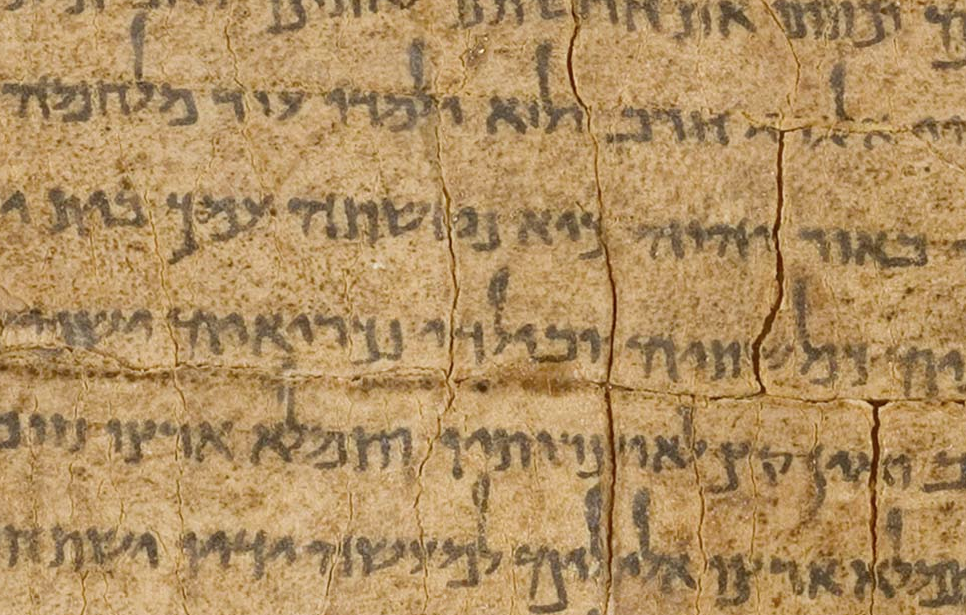
The Great Isaiah Scroll of Qumran
Some detail from the Great Isaiah Scroll of Qumran

Executive summary

So, how, if at all, have the Qumran Scrolls influenced the NJPS English translation of the book of Isaiah?

A short answer is: Qumran is mentioned 16 footnotes. In all 16, only manuscript 1QIsa-a is mentioned. (The NJPS footnotes refer to it as 1QIs-a, i.e. Isaiah is abbreviated to "Is" not "Isa".)

In only 4 of those places does the footnote correspond to an actual influence on the body text. In the other 12 places, Qumran is only mentioned in the footnote.

The Details

It is possible that the Qumran influenced the NJPS Isaiah in ways that were not noted, but that is more difficult or even impossible to know.

So, we'll confine ourselves to influences that can be seen in the body text and footnotes. In particular, let's start with the four influences on the body text.

Below, we use italics to indicate which span of text the footnote is commenting on. (The NJPS uses superscripted lowercase letters and dashes to do this.)

Below, the column label "c.v (p)" means "chapter.verse (page number)". An additional chapter and verse in curly braces sometimes follows. This is to provide the chapter and verse used by Christian Bibles. E.g. the first selection below, Isaiah 8.23, is identified as Isaiah 9.1 in Christian Bibles.

Body text influences of Qumran on the NJPS
c.v
(p)
body text footnote
8.23
{9.1}
(633)
For if there were to be any break of day for that [land] which is in straits, only the former [king] would have brought abasement to the land of Zebulun and the land of Naphtali—while the later one would have brought honor to the Way of the Sea, the other side of the Jordan, and Galilee of the Nations. So 1QIs-a; the others have “there is not.”
14.4
(645)
you shall recite this song of scorn over the king of Babylon:

How is the taskmaster vanished,
How is oppression ended!
Reading marhebah with 1QIs-a (cf. Septuagint). The traditional reading madhebah is of unknown meaning.
37.27
(694)
Their inhabitants are helpless,
Dismayed and shamed.
They were but grass of the field
And green herbage,
Grass of the roofs that is blasted
Before the east wind.
So ms. 1QIs-a; cf. 2 Kings 19.26. The usual reading in our passage means, literally, “and a field [?] before standing grain.”
60.19
(748)
No longer shall you need the sun
For light by day,
Nor the shining of the moon
For radiance [by night];
For the LORD shall be your light everlasting,
Your God shall be your glory.
So 1QIs-a, Septuagint, and Targum.

Here are the 12 influences that are only seen in a footnote.

Footnote-only mentions of Qumran in the NJPS
c.v
(p)
body text footnote
3.24
(623)
And then—
Instead of perfume, there shall be rot;
And instead of an apron, a rope;
Instead of a diadem of beaten-work,
A shorn head;
Instead of a rich robe,
A girding of sackcloth;
A burn instead of beauty.
The complete Isaiah scroll from Qumran, hereafter 1QIs-a, reads “For shame shall take the place of beauty”; cf. note k.
9.8
{9.9}
(635)
But all the people noted—
Ephraim and the inhabitants of Samaria—
In arrogance and haughtiness:
1QIs-a reads “shouted.”
9.16
{9.17}
(636)
That is why my Lord
Will not spare their youths,
Nor show compassion
To their orphans and widows;
For all are ungodly and wicked,
And every mouth speaks impiety.
Cf. Arabic samuḥa. 1QIs-a reads yḥmw.
11.6
(640)
The wolf shall dwell with the lamb,
The leopard lie down with the kid;
The calf, the beast of prey, and the fatling together,
With a little boy to herd them.
1QIs-a reads: “The calf and the beast of prey shall feed”; so too the Septuagint.
21.8
(658)
[like] a lion he called out:
“On my Lord’s lookout I stand
Ever by day,
And at my post I watch
Every night."
1QIs-a reads “The watcher.”
29.5
(675)
“And like fine dust shall be
The multitude of your strangers;
And like flying chaff,
The multitude of tyrants.”
And suddenly, in an instant,
Manuscript 1QIs-a reads “haughty men.”
33.8
(685)
Highways are desolate,
Wayfarers have ceased.
A covenant has been renounced,
Cities rejected
Mortal man despised.
1QIs-a reads “A pact.”
34.4
(687)
All the host of heaven shall molder.
The heavens shall be rolled up like a scroll,
And all their host shall wither
Like a leaf withering on the vine,
Or shriveled fruit on a fig tree.
1QIs-a reads “And the valleys shall be cleft,/And all the host of heaven shall wither.”
34.5
(688)
For My sword shall be drunk in the sky;
Lo, it shall come down upon Edom,
Upon the people I have doomed,
To wreak judgment.
1QIs-a reads “be seen”; cf. Targum.
40.6
(698)
A voice rings out: “Proclaim!”
Another asks, “What shall I proclaim?”
“All flesh is grass,
All its goodness like flowers of the field"
1QIs-a and Septuagint read “And I asked.”
43.19
(709)
I am about to do something new;
Even now it shall come to pass,
Suddenly you shall perceive it:
I will make a road through the wilderness
And rivers in the desert.
1QIs-a reads “paths”; cf. v. 16.
49.12
(724)
Look! These are coming from afar,
These from the north and the west,
And these from the land of Sinim.
1QIs-a reads “the Syenians”; cf. Ezek. 30.6.

Conclusion

Influences of 1QIsa-a are apparent in the NJPS Isaiah. But, these influences are far from dramatic. Some might even call them minuscule. This is true of Qumran influences on most modern biblical translations. This comes from the fact that most Qumran manuscripts do not differ dramatically from the previous main sources for biblical translations, namely Masoretic and Septuagint manuscripts. Perhaps it is this agreement that is the most dramatic thing about the Qumran manuscripts!

Before I knew much about the Qumran scrolls, I expected they would have a larger influence on modern biblical translations. In particular, I naively thought to myself, "well if these are the oldest available original language (Hebrew) texts, they will be considered authoritative and thus resolve all difficulties."

This thought was naive in many different ways.

These are indeed the oldest available original language (Hebrew) texts. But it is far from clear that they should be considered authoritative. All they are (though this is a lot) is great additional witnesses, to be considered along with the Masoretic Hebrew texts as well as ancient translations, most notably the Targum (in Aramaic) and the Septuagint (in Greek). The Qumran scrolls add to, rather than "trump" these other witnesses.

For example, though they are old, they're not older than the Septuagint.

Also, though age is one factor to consider when weighing a witnesses' authority, it is hardly the only factor. What's to say an older manuscript might not have been made by a scribe who was more error-prone, or more willing to impose his own views?

Finally, and this one was the biggest revelation to me, the Qumran scribes were not necessarily more fluent in ancient Hebrew than a modern scholar! I didn't realize that Hebrew ceased to be an everyday language as a result of the Babylonian exile, 500 some-odd years BCE. The Great Isaiah Scroll was transcribed about 400 years later!

Perhaps the analogy is strained, but this is something like me transcribing Shakespeare, which certainly contains many words I am unfamiliar with.

In this light, let's imagine that the scribe of the Great Isaiah Scroll came across the word madhebah in his source for 14:4. He might have been at as great a loss as a modern scholar in understanding this word, and thus may have chosen to emend the dalet to a resh, making it marhebah (oppression).

This decision seems like a good one. But it does not render the Masoretic's madhebah wrong beyond a reasonable doubt. Admittedly, this is not a criminal court case, and thus the standard of reasonable doubt may be inappropriate. On the other hand, to some people, these texts are in some sense a matter of life or death, or even of the spiritual domain beyond life and death. So some circumspection is called for.

To me, the NJPS has the proper level of circumspection. It takes the dalet-to-resh emendation of 1QIsa-a and the Septuagint, but notes it. By the way, an interesting question is whether the NJPS would have taken the dalet-to-resh emendation of the Septuagint without Qumran support.

To digress for a moment, a related question I'm interested in is whether the Septuagint was under-appraised by Jewish scholars until evidence from Qumran "legitimized" some of the Septuagint's divergences from the Masoretic. It is possible that the Septuagint was under-appraised because it was in Greek or because in many ways it came to be used by Christians as the Old Testament that "went with" the New. Perhaps comparing the attitude towards the Targums would help here, since they are ancient translations in a more persistently Jewish-associated language.

To digress upon my digression: Before I learned about the Septuagint and the large contingent of Greek-speaking Jews of Alexandria, I thought it was "un-Jewish" to refer to the books of the Torah by their English names, since these are directly derived from their Greek names. I thought, in my sophomoric smarty-pants way, that this smacked of Christian influence. Now I (think I) know better. Greek is a perfectly "legitimate" Jewish language, historically speaking.

Okay I better stop writing about things that some people have devoted their lives to, whereas I have only recently begun to dabble in.

In that fleeting spirit of humility, let me conclude by listing some sources I found helpful on these topics.

References

Reference 1 of 3. Harold Scanlin, The Dead Sea Scrolls & Modern Translations of the Old Testament.

Cover of Scanlin's The DSS & Modern Translations of the OT

Among other things, Scanlin's book does what I did above, but for the whole Old Testament, and for many translations. The NJPS is one of the translations he covers, though he abbreviates it NJV. He misses, or chooses not to mention, some of the NJPS influences I list above. Thus I contribute some small thing on top of his huge work.

Reference 2 of 3. Lawrence H. Schiffman, The Modern Scholar: The Dead Sea Scrolls: The Truth Behind the Mystique.

Graphic for Schiffman's The DSS: Truth Behind the Mystique

This is a recording of 14 great lectures of about 35 minutes each, for a total of 8 hours.

Reference 3 of 3. Harvey Minkoff, "Searching for the Better Text: How errors crept into the Bible and what can be done to correct them," Bible History Daily. (http://www.biblicalarchaeology.org/daily/biblical-topics/bible-interpretation/searching-for-the-better-text-2/.)